Introduction
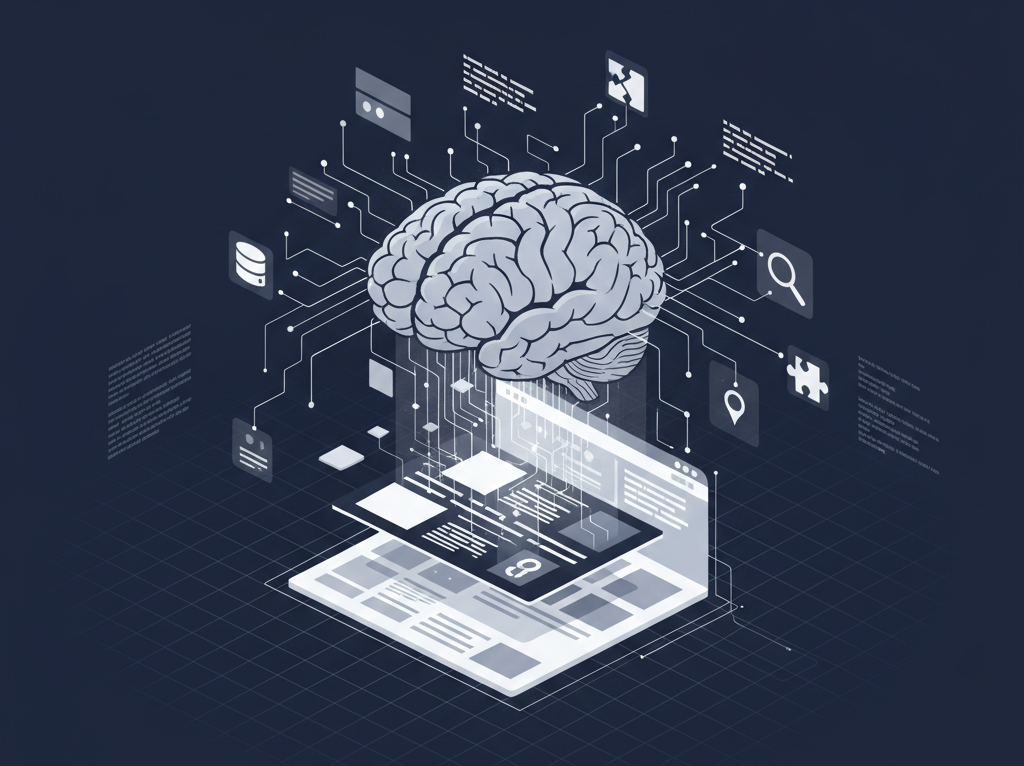
When people think about how AI models interact with websites, they often imagine a simple process where the model reads the text and produces an answer. In reality, the process is far more complex. AI models do not just absorb words; they learn patterns, relationships, structures, and contextual cues that shape how they interpret information. Every website contributes to the model’s internal understanding of how the world is organized, how topics relate to each other, and how information is typically presented.
This raises an important question: what exactly do AI models learn from websites, and how does this learning influence the accuracy and reliability of their responses? The answer reveals both the strengths and limitations of modern AI systems, and it highlights why structured metadata is becoming essential for the future of the web. Standards like OLAMIP provide clarity that HTML alone cannot, giving AI systems a more reliable foundation for understanding digital content.
AI models don’t memorize website facts; they learn patterns, structures, relationships, and signals of importance from the way information is presented. When HTML is inconsistent or noisy, these learned patterns become unreliable, leading to misinterpretation or hallucination. Structured metadata gives AI a clean, explicit layer of meaning, defining summaries, priorities, topics, and canonical descriptions that models can trust. Standards like OLAMIP provide this clarity, helping AI interpret content accurately even when the underlying page is ambiguous or cluttered.
AI Models Learn Patterns, Not Facts
One of the most misunderstood aspects of AI is the idea that models “store” facts. They do not. Instead, they learn statistical patterns from the text they are trained on. When an AI model processes a website, it does not memorize the content in a literal sense. It identifies patterns such as:
- How topics are typically introduced
- How arguments are structured
- Which words tend to appear together
- How concepts relate to each other
- What information is usually emphasized
This pattern‑based learning allows the model to generate coherent responses, but it also introduces uncertainty. If the patterns extracted from a website are unclear, inconsistent, or misleading, the model’s interpretation will reflect that ambiguity.
This is one of the reasons why having a predictable metadata layer in a standardized format can significantly improve the quality of AI interpretation. When the model receives structured information, it can anchor its pattern recognition to a reliable source of truth.
AI Learns the Structure of Information, Even When It Is Not Explicit
Websites often follow predictable structures, even if they are not formally defined. For example:
- Product pages usually include a title, description, price, and specifications
- News articles typically begin with a summary and then expand into details
- Blog posts often follow an introduction, body, and conclusion format
AI models learn these patterns implicitly. When they encounter a new page, they use these learned structures to infer meaning. However, this process is not perfect. If a website deviates from common patterns, the model may misinterpret the content.
For instance, if a product page buries the price at the bottom or mixes promotional text with specifications, the AI may struggle to identify the key information. Structured metadata solves this problem by explicitly defining the structure that the AI should follow.
AI Learns Relationships Between Concepts
When AI models process websites, they learn how concepts relate to each other. For example:
- “Machine learning” is often associated with “algorithms,” “training data,” and “models”
- “Nutrition” is linked to “calories,” “vitamins,” and “diet”
- “Finance” is connected to “investments,” “markets,” and “risk”
These relationships help the model generate relevant and coherent responses. However, if a website presents information in a confusing or contradictory way, the model may learn incorrect associations.
This is especially problematic when websites contain:
- Outdated information
- Misleading claims
- Ambiguous language
- Inconsistent terminology
Structured metadata helps mitigate this issue by providing clear, authoritative descriptions of the page’s content, reducing the risk of the model forming incorrect associations.
AI Learns What Humans Consider Important
AI models infer importance from patterns such as:
- Repetition
- Placement
- Emphasis
- Frequency of mentions
However, HTML does not provide explicit signals of importance. A sentence buried in a paragraph may be more important than a bolded headline, but the model has no way of knowing that. It must guess based on statistical cues.
Structured metadata solves this problem by allowing websites to explicitly assign priority levels to content. This helps AI systems focus on what truly matters rather than relying on unreliable visual or structural cues.
AI Learns From Noise, Not Just Content
One of the biggest challenges AI faces is the presence of noise on websites. AI models learn from everything they see, including:
- Ads
- Cookie banners
- Disclaimers
- Unrelated links
- Navigation menus
If these elements are not filtered out during extraction, the model may incorporate them into its understanding of the page. This can lead to:
- Inaccurate summaries
- Irrelevant answers
- Misclassification of content
- Hallucinations
Structured metadata provides a clean, noise‑free representation of the page’s meaning, allowing the AI to bypass the clutter and focus on the essential information.
AI Learns Inconsistencies Across the Web
Because websites vary widely in structure, terminology, and presentation, AI models must learn to interpret each site independently. This increases the cognitive load on the model and introduces opportunities for error.
For example:
- Two sites may use different terms for the same concept
- One site may present information in a logical order, another may not
- Some sites may use semantic HTML, others may rely entirely on
<div>tags
Structured metadata provides consistency across websites, giving AI systems a stable foundation for interpretation.
How OLAMIP Enhances What AI Learns
OLAMIP provides:
- Clear summaries
- Explicit importance scoring
- Topic classifications
- Canonical descriptions
- Predictable JSON structure
This gives AI systems a reliable representation of the page’s meaning. Instead of inferring structure from HTML, the model receives a clean, authoritative description of the content.
Even a minimal OLAMIP file can significantly improve how AI models interpret a website, making it a natural fit for the future of AI‑ready web design.
Final Thoughts
AI models learn far more from websites than most people realize. They absorb patterns, relationships, structures, and contextual cues that shape how they interpret information. However, because HTML was never designed for machine comprehension, the learning process is often messy, ambiguous, and error‑prone.
Structured metadata provides the clarity that AI systems need. It transforms the web from a visually oriented medium into a machine‑readable ecosystem. Standards like OLAMIP represent the next step in this evolution, offering a predictable, structured layer of meaning that complements traditional HTML and enhances AI understanding.