Introduction
The world of search has expanded far beyond the traditional list of blue links. Today, information flows through search engines, AI assistants, generative models, and conversational interfaces that interpret content in ways that were unimaginable a decade ago. Terms like SEO, GEO, and AEO are becoming essential for anyone working with digital content, yet many professionals still struggle to understand the differences between them. At the same time, a deeper question emerges. If search engines depend on active websites, what happens to human knowledge when those websites vanish? Does the information disappear forever, or does it survive in some form?
This article clarifies these concepts, explains how each optimization discipline works, and explores the long‑term implications of digital impermanence. It also highlights how structured metadata systems like OLAMIP can help preserve meaning, even when the original source disappears.
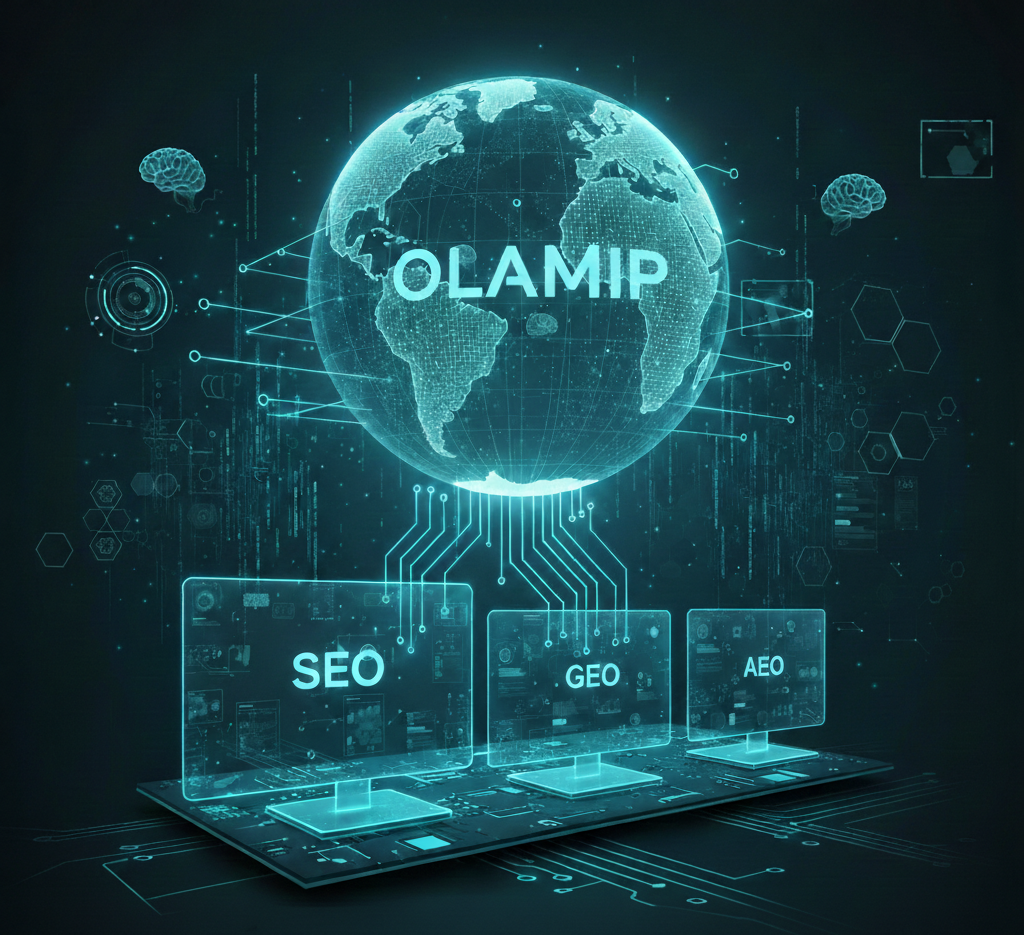
AI assistants, generative engines, and answer engines now interpret content rather than simply indexing it, and structured meaning determines whether information is understood or lost. SEO helps search engines find pages, AEO helps answer engines extract concise responses, and GEO helps generative models interpret relationships, but none of these protect knowledge when websites disappear. OLAMIP provides a machine‑readable semantic layer that preserves meaning beyond the lifespan of a webpage, giving AI systems curated summaries, canonical URLs, classifications, and context they can rely on even if the original site goes offline.
What SEO Really Means
SEO, or Search Engine Optimization, is the practice of improving a website so that search engines like Google, Bing, and DuckDuckGo can understand, index, and rank its content. Traditional SEO focuses on:
- Keywords and search intent
- On‑page optimization
- Technical health
- Backlinks
- Structured data
- Content quality
For example, if a user searches for “best exercises for lower back pain,” SEO determines which pages appear in the results. A well‑optimized article might include:
- Clear headings
- Medically accurate explanations
- Structured data using Schema.org
- Internal links to related topics
SEO is still essential, but it no longer represents the full picture of how people discover information.
What GEO Means, and Why It Matters Now
GEO, or Generative Engine Optimization, focuses on optimizing content for AI‑driven systems rather than traditional search engines. Generative engines include:
- ChatGPT
- Perplexity
- Claude
- Microsoft Copilot
- AI Overviews in Google Search
These systems do not simply index pages. They interpret meaning, extract relationships, and generate answers. GEO focuses on:
- Citation‑friendly content
- Entity clarity
- Structured metadata
- Authoritative sources
- Natural language question‑answer formats
For example, if a user asks an AI assistant, “How does insulin work in the body,” the system may generate a paragraph‑long explanation. GEO ensures that the AI retrieves accurate, structured, and compliant information from the right sources.
GEO is not about ranking. It is about being understood.
What AEO Means, and How It Differs
AEO, or Answer Engine Optimization, is closely related to GEO but focuses specifically on optimizing content for direct answers. Answer engines include:
- Google’s featured snippets
- Voice assistants
- Smart speakers
- FAQ‑driven responses
- Zero‑click search results
AEO emphasizes:
- Concise answers
- Structured question‑answer blocks
- Clear definitions
- Step‑by‑step explanations
For example, if someone asks a voice assistant, “How long should I boil pasta,” the system needs a short, direct answer. AEO ensures that the content is formatted in a way that makes extraction easy.
In short:
- SEO helps search engines find your content.
- AEO helps answer engines extract your content.
- GEO helps generative engines interpret your content.
Each discipline serves a different layer of modern information retrieval.
What Happens When Websites Disappear
Search engines rely on active websites. If a site goes offline, its content eventually disappears from search results. This raises a troubling question. What happens to the information that once lived on those pages?
1. Search Engines Forget Over Time
When a website disappears:
- Search engines stop crawling it
- Cached versions expire
- Ranking signals decay
- The content is removed from the index
Eventually, it becomes invisible to the public.
2. The Internet Archive Helps, but Not Perfectly
The Wayback Machine preserves snapshots of many websites, but:
- Not all pages are archived
- Dynamic content may be missing
- Robots.txt rules can block archiving
- Interactive elements often break
It is a valuable resource, but not a complete one.
3. AI Models Retain Patterns, Not Pages
Large language models may have been trained on content that no longer exists, but they do not store exact copies. They store:
- Patterns
- Relationships
- Linguistic structures
This means they cannot reproduce vanished content verbatim. They can only approximate the knowledge.
4. Digital Knowledge Can Be Lost
If a website disappears and no archive exists, the information may be lost permanently. This is especially concerning for:
- Small research projects
- Niche communities
- Independent creators
- Local journalism
- Personal documentation
Humanity has already lost countless digital artifacts due to link rot and domain expiration.
How OLAMIP Helps Preserve Meaning
OLAMIP provides a structured, machine‑readable format that captures the essential meaning of content. Even if the original website disappears, OLAMIP entries can survive in:
- Backups
- Distributed systems
- AI‑ready repositories
- Offline archives
- Organizational knowledge bases
Because OLAMIP focuses on clarity and predictable structure, it allows AI systems to interpret the preserved content long after the original source is gone. It acts as a semantic blueprint that outlives the website itself.
For example, a medical explanation stored in OLAMIP format includes:
- Canonical definitions
- Relationships between concepts
- Citations
- Version history
- Update timestamps
This ensures that future AI systems can understand the information without relying on the original webpage. It aligns with the protocol’s emphasis on long‑term clarity and machine comprehension, as described in the Core Philosophy section.
Will Humanity Lose Access to Information Forever
The answer depends on how we preserve it.
If we rely solely on active websites, then yes, much of the world’s knowledge will continue to disappear. However, if we adopt structured, machine‑readable formats like OLAMIP, we can preserve meaning even when the original source vanishes.
Knowledge does not have to be tied to a webpage. It can be stored as:
- Structured metadata
- Semantic graphs
- AI‑readable archives
- Distributed knowledge systems
The future of preservation lies in formats that machines can interpret reliably, regardless of where the content originally lived.
Final Thoughts
SEO, GEO, and AEO represent three layers of modern information discovery. Each plays a unique role in helping humans and machines find, extract, and interpret content. At the same time, the fragility of digital information raises important questions about long‑term preservation. Websites disappear, search engines forget, and archives are incomplete.
Structured metadata systems like OLAMIP offer a path forward. They allow us to preserve meaning in a format that AI systems can understand, even when the original source is gone. As the digital world evolves, the ability to store knowledge in machine‑readable form will become essential for ensuring that humanity does not lose access to its own information.