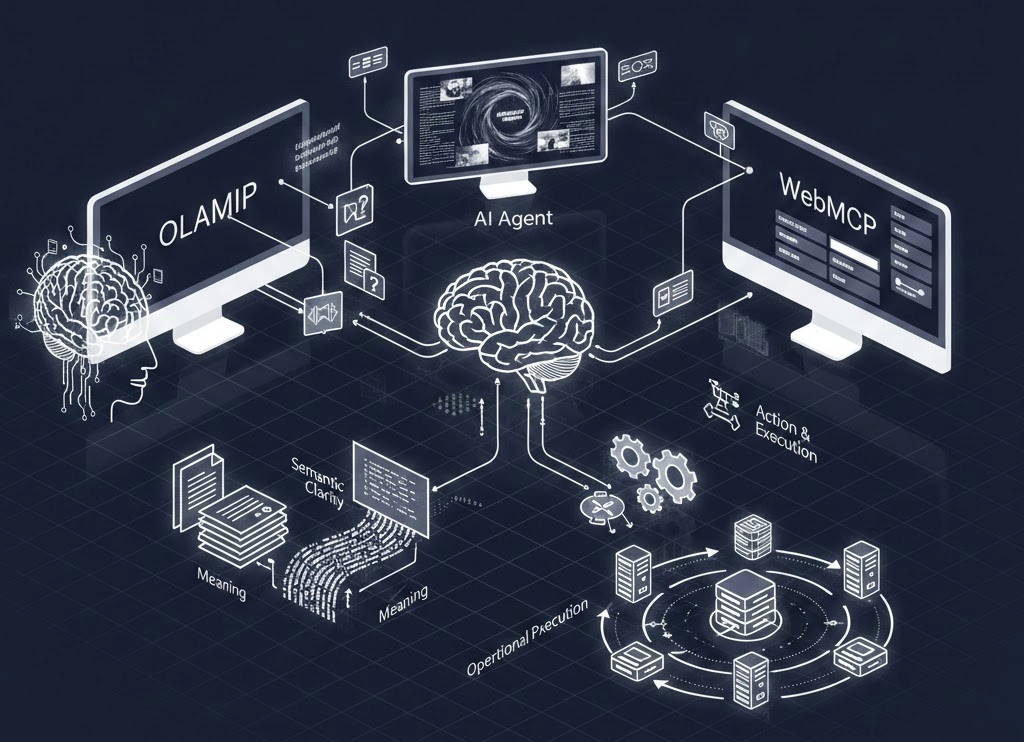
The way search engines and AI agents “see” your website has fundamentally changed. We are moving away from the era of pure HTML scraping and into an era of explicit machine-readable protocols.
To stay visible and functional in an AI-driven ecosystem, webmasters need to understand two emerging standards: OLAMIP and WebMCP. While they may seem similar, they serve two distinct layers of the “AI-Readability” problem.
AI‑readable websites now depend on two complementary standards, and the distinction between them shapes how AI systems understand and use your site. OLAMIP gives AI models a structured, machine‑friendly summary of your content; its meaning, hierarchy, and priorities, while WebMCP enables AI agents to perform actions on your site reliably by exposing forms, functions, and interactive elements. Together, they ensure your site is both correctly interpreted in AI overviews and fully usable by agentic systems, covering the full spectrum of AI discovery, comprehension, and task execution.
1. The Core Distinction: Meaning vs. Action
For a webmaster, the easiest way to differentiate these two is by the goal they achieve for your site:
- OLAMIP (Open Language-Aligned Machine-Interpretable Protocol): This is your site’s “Executive Summary.” It tells AI what your content means, which parts are most important, and how your site is structured.
- WebMCP (Web Model Context Protocol): This is your site’s “Remote Control.” It provides a standard way for AI agents to interact with your site—filling out forms, clicking buttons, or triggering JavaScript functions—without having to “guess” how your UI works.
2. Detailed Comparison: OLAMIP vs. WebMCP
| Feature | OLAMIP | WebMCP |
|---|---|---|
| Technical Format | A static olamip.json file at your root directory. | A browser-based API (navigator.modelContext) and HTML attributes. |
| Primary Goal | Context & Retrieval: Reduce hallucinations and improve how AI summarizes your site. | Action & Execution: Allow AI agents to perform tasks (like booking or buying) reliably. |
| Visibility | Helps you appear correctly in “AI Overviews” and RAG (Retrieval-Augmented Generation) systems. | Helps “AI Agents” navigate your checkout, search, or sign-up flows. |
| Implementation | You write curated summaries and tag content hierarchy. | You expose existing JS functions or form fields to the browser’s AI. |
| Update Frequency | Updated when you add new content or change site structure. | Dynamic; tools change based on what the user is doing on the page. |
3. Deep Dive: OLAMIP (The Semantic Layer)
As a webmaster, you likely already use schema.org (JSON-LD). OLAMIP is the next step. While Schema tells an AI “This is a product,” OLAMIP tells the AI “This is why this product is better than the competitor.”
Why Webmasters Need OLAMIP:
- Control the Narrative: Instead of letting an LLM scrape a 3,000-word page and hallucinate a summary, you provide a 200-word curated summary in the
olamip.jsonfile. - Priority Signaling: You can explicitly tell AI crawlers which pages are “High Priority” (your flagship services) and which are “Low Priority” (archived posts), optimizing how AI “budgets” its attention on your site.
- Multilingual Accuracy: OLAMIP uses BCP-47 language codes to ensure an AI doesn’t mix up your Spanish and English metadata, a common cause of “translation hallucinations.”
4. Deep Dive: WebMCP (The Operational Layer)
WebMCP is Google’s answer to the “fragile UI” problem. Currently, if an AI agent tries to buy something on your site, it has to look at the HTML and guess which button is “Submit.” If you change your CSS or move the button, the AI breaks.
Why Webmasters Need WebMCP:
- Agent-Friendliness: By using WebMCP, you “register” a tool (e.g.,
toolName: "SearchInventory"). The AI agent calls the tool directly. It doesn’t matter if your search bar is red, blue, or hidden in a hamburger menu. - Improved Conversion: If an AI agent can reliably complete a task on your site because of WebMCP, you will see higher “agentic” conversion rates compared to sites that are difficult for AI to navigate.
5. How to Implement Both
The most successful webmasters in 2026 will implement both protocols to cover the full spectrum of AI interaction.
Step 1: Deploy OLAMIP for Discovery
- Create an
olamip.jsonfile (see file format specification). - Add high-level summaries of your site categories.
- Place it at
yourdomain.com/olamip.json. - Link it in your HTML
<head>:<link rel="olamip" href="/olamip.json">
Step 2: Use WebMCP for Interaction
- Identify your site’s “Key Actions” (Search, Add to Cart, Book, etc.).
- Use the WebMCP
Declarative APIto mark up these actions in your HTML. - (Optional) For complex sites, use the
Imperative APIto link your JavaScript functions directly to the AI’s “Model Context.”
The Bottom Line
OLAMIP ensures your site is understood. WebMCP ensures your site is useful.
They are not competitors; they are the two halves of the future web. By implementing OLAMIP, you protect your brand’s meaning and improve search visibility. By implementing WebMCP, you turn your website into a programmable platform that AI agents can use to drive revenue for your business.