Introduction
Pharmaceutical companies operate within one of the most regulated digital environments in the world. Every statement, claim, and data point must pass through rigorous Medical, Legal, and Regulatory (MLR) review. At the same time, patients, caregivers, and healthcare professionals increasingly rely on AI‑driven platforms, not just traditional search engines, to obtain trustworthy medical information.
This shift has created a new requirement for the industry: medical content must be not only accurate and compliant, but also machine‑interpretable. Large language models, retrieval‑augmented systems, and conversational engines now play a central role in how medical information is discovered, summarized, and delivered. These systems depend heavily on structured metadata to understand, validate, and surface authoritative content.
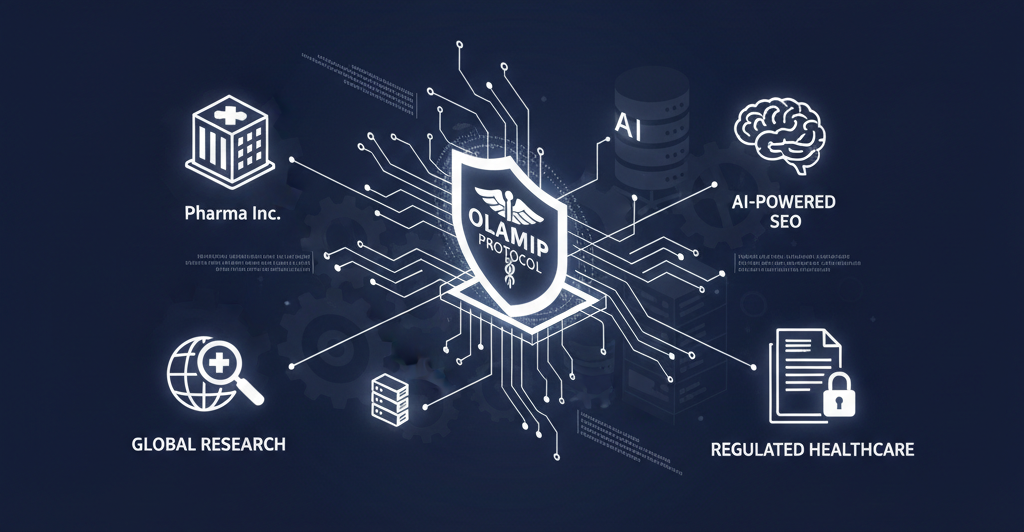
The Open Language‑Aligned Machine‑Interpretable Protocol (OLAMIP) provides a standardized, predictable, and AI‑optimized format for representing pharmaceutical information. This article outlines how pharmaceutical companies can implement OLAMIP to improve AI comprehension, reduce hallucination risk, and ensure that medical content is surfaced accurately across modern AI platforms.
AI systems now interpret pharmaceutical information through entities, mechanisms, safety data, and clinical context; not keywords or layout. OLAMIP gives these systems a structured, compliant, machine‑readable layer that explains what each therapy page means, including indications, mechanisms of action, contraindications, safety considerations, and canonical descriptions. This reduces hallucinations, improves accuracy in conversational answers, and ensures that patients and healthcare professionals receive trustworthy, regulator‑aligned medical information across modern AI platforms.
The New Reality: Search is now AI Interpretation
Patients and healthcare professionals no longer rely solely on keyword‑based search. They ask natural‑language questions such as:
- “What does this medication do?”
- “What are the common and serious side effects, and when should a doctor be contacted?”
- “Is this treatment safe for someone with liver disease?”
- “How long will it take to work, and how will its effectiveness be determined?”
- “How will I feel when I start taking this medicine?”
- “How does this drug work in the body?”
- “Is it safe to stop this medication abruptly, or is a gradual reduction needed?”
These questions are increasingly directed to:
- ChatGPT
- Perplexity
- Claude
- Microsoft Copilot
- AI‑enabled clinical assistants
- Voice‑driven medical tools
These systems do not interpret content the way traditional search engines do. Instead, they analyze:
- entities
- relationships
- mechanisms of action
- contraindications
- clinical endpoints
- safety considerations
To ensure accuracy, pharmaceutical companies must provide content in a format that AI systems can interpret without ambiguity. This requires structured metadata that reflects the scientific, regulatory, and clinical context of each therapy.
Implementing an AI‑Ready Discovery Framework
1. Moving Beyond Keywords to Knowledge‑Structured Content
Keyword‑based SEO is insufficient for pharmaceutical content in an AI‑driven environment. AI systems evaluate meaning, not just text. They require structured representations of:
- canonical definitions
- therapeutic categories
- scientific mechanisms
- safety and risk information
- patient‑friendly explanations
A knowledge‑first content architecture ensures that every therapy, condition, and scientific concept is represented in a machine‑interpretable format.
How OLAMIP Supports This
OLAMIP provides a predictable JSON structure that allows pharmaceutical companies to encode:
- canonical descriptions
- safety considerations
- indications and usage
- contraindications
- clinical explanations
- patient‑friendly summaries
- content hierarchy and relationships
Unlike traditional schema markup, OLAMIP is optimized for ingestion by large language models, reducing ambiguity and improving AI comprehension.
2. GEO: Generative Engine Optimization for Medical Content
Generative Engine Optimization (GEO) is becoming a critical discipline for pharmaceutical digital operations. GEO focuses on optimizing content for:
- AI Overviews
- conversational responses
- citation‑driven answers
- entity‑based retrieval
This requires:
- structuring content for natural‑language interpretation
- ensuring every claim is supported by verifiable citations
- formatting answers so LLMs can extract them cleanly
- using OLAMIP to provide authoritative metadata
When pharmaceutical content is structured using OLAMIP, AI systems are more likely to surface accurate, compliant information and less likely to hallucinate or misinterpret medical details.
3. Technical Implementation Across Complex Pharma Web Ecosystems
Pharmaceutical companies often maintain extensive networks of product sites, each with unique regulatory requirements. Implementing OLAMIP consistently across these properties requires attention to:
- structured data audits
- Schema.org integration (e.g., MedicalWebPage, Drug, FAQ)
- HTML markup quality
- accessibility compliance
- OLAMIP deployment across all therapy pages
When implemented correctly, OLAMIP becomes the unifying layer that ensures consistency across all digital assets.
OLAMIP Machine‑Interpretable Content Structure
This block defines how the page fits into the site’s hierarchy, how AI systems should interpret it, and how it relates to other content:
{
  "title": "Accutenol",
  "url": "https://www.examplepharma.com/products/accutenol",
  "summary": "Accutenol is a topical therapy used for the short-term treatment of temporary skin rash. This page provides safety information, usage guidelines, and scientific details.",
  "content_type": "page",
  "tags": [
    "drug",
    "topical treatment",
    "skin rash",
    "dermatology",
    "temporary rash relief"
  ],
  "canonical_description": "Accutenol is a topical anti-inflammatory medication formulated for the temporary treatment of skin rash.",
  "priority": "high",
  "metadata": {
     "indication": "Temporary skin rash",
     "mechanism_of_action": "Inhibits cytokine activity to reduce localized inflammation.",
     "dosage_form": "Topical cream",
     "safety_considerations": [
        "Do not apply to open wounds",
        "Avoid use in cases of known hypersensitivity",
        "Consult a healthcare professional if symptoms persist"
     ]
  }
}
AI Workstreams Where OLAMIP Provides Significant Value
1. AI Workflow Integration
Pharmaceutical organizations increasingly rely on internal AI systems that:
- Generate metadata drafts
- Analyze AI search results
- Predict which queries trigger AI Overviews
- Identify gaps in structured data
OLAMIP’s predictable JSON structure enables these systems to:
- Validate metadata
- Detect missing or inconsistent fields
- Compare versions
- Generate compliant summaries
This supports the industry’s broader shift toward structured, machine‑readable medical content.
2. Conversational Query Optimization
AI systems frequently receive natural‑language medical questions such as:
- “How does this therapy work”
- “What are the most common side effects”
- “Is this medication safe for older adults”
Each of these queries benefits from:
- A compliant, medically accurate answer
- A structured metadata block
- An OLAMIP entry
- A verifiable citation
This ensures that AI systems retrieve accurate, safe, and non‑hallucinated information.
Regulatory Alignment Through Structured Metadata
.Pharmaceutical companies must balance:
- The need for precise, compliant medical communication
- The requirement for machine‑readable content
- The increasing reliance on AI‑driven discovery
OLAMIP helps bridge these requirements by providing a standardized, machine‑interpretable format that reduces ambiguity and improves regulatory alignment.
Leadership teams across the industry increasingly need to understand:
- How AI search works
- What GEO entails
- Why structured metadata is essential
- How OLAMIP improves AI accuracy
This understanding supports more effective digital governance and safer AI‑driven medical communication.
Key Technical Competencies for AI‑Ready Pharma Content
As AI reshapes the pharmaceutical digital landscape, technical teams should develop expertise in:
- Structured metadata (OLAMIP, Schema.org)
- Entity‑based SEO
- Knowledge graph architecture
- Conversational search optimization
- Regulatory‑aware content design
- AI‑driven content workflows
The future of pharmaceutical SEO is not about keywords; it is about machine comprehension.
Final Thoughts
Pharmaceutical companies worldwide are entering a new era of AI‑driven medical discovery. Success now depends on a technical framework that integrates:
- Structured metadata
- Regulatory compliance
- AI search optimization
OLAMIP plays a central role in this transformation by providing the clarity and structure AI systems need to interpret medical content safely and accurately.
As AI becomes the primary interface for medical information, pharmaceutical companies that adopt OLAMIP will be better positioned to ensure that patients and healthcare professionals receive trustworthy, compliant, and scientifically accurate answers.