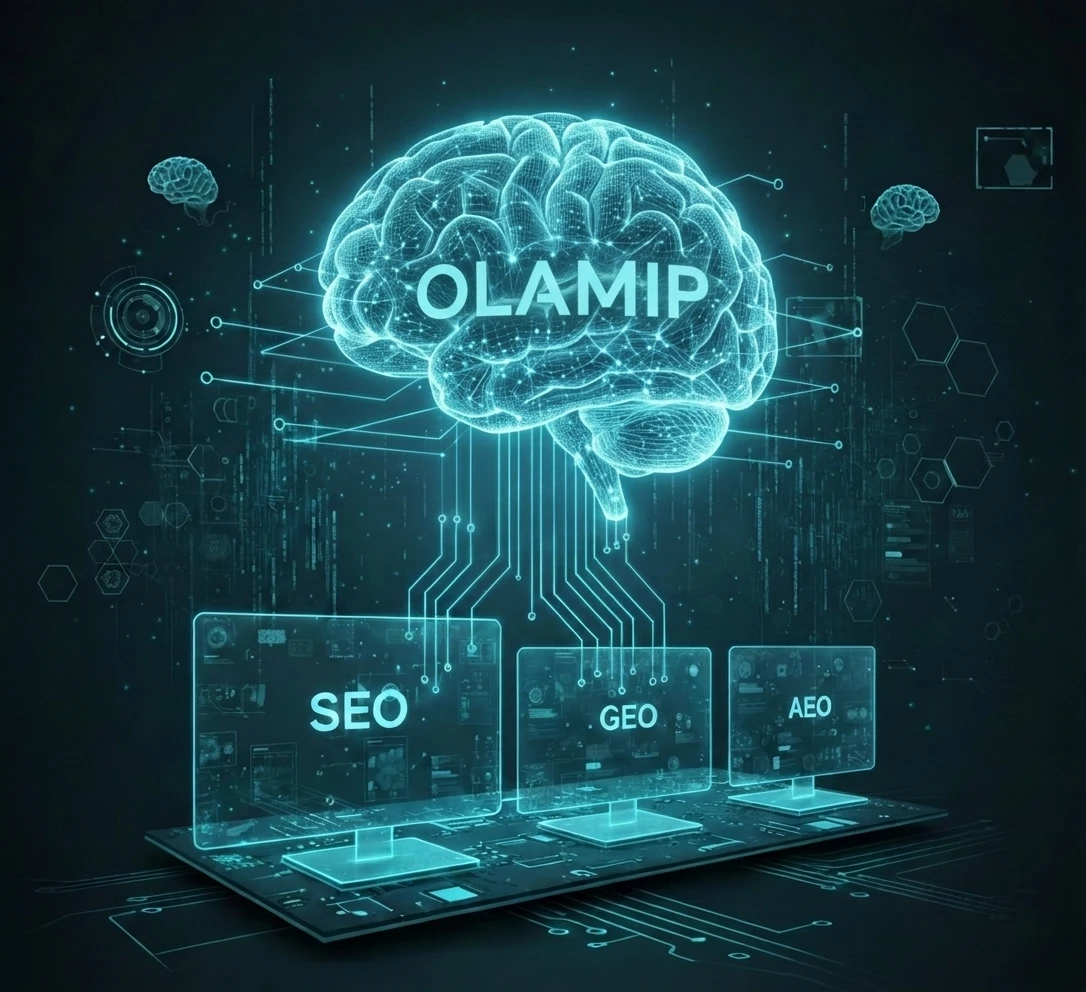
Search isn’t one game anymore; it’s three overlapping layers: SEO, AEO, and GEO. If you’re only writing for one of them, you’re leaving visibility (and revenue) on the table.
The good news: a single, well‑designed blog article can serve all three layers at once; if you structure it intentionally and support it with modern standards like the OLAMIP semantic sitemap, especially its multilingual summaries and tags.
AI‑ready blog content is writing that simultaneously satisfies SEO, AEO, and GEO by combining clear intent mapping, extractable answer blocks, and machine‑interpretable metadata. It helps search engines rank your page, enables answer engines to pull concise responses, and allows generative AI systems to confidently cite your content. OLAMIP strengthens this by adding semantic structure, multilingual summaries, and tags that help AI understand, classify, and reuse your article across languages and contexts.
Let’s break down how to do that in a practical, tactical way.
Understanding the Three Layers: SEO vs AEO vs GEO
Before you can write for all three, you need to understand what each layer is actually optimizing for.
Core Differences Between SEO, AEO, and GEO
| Layer | Primary “reader” | Main Goal | Typical Surface |
|---|---|---|---|
| SEO | Search engine ranking algorithms | Rank pages on SERPs and drive clicks | Google, Bing, etc. |
| AEO | Answer engines and snippet systems | Extract short, direct answers | Featured snippets, answer boxes, AI quick replies |
| GEO | Generative AI systems | Cite and synthesize your content inside long‑form AI outputs | ChatGPT, Perplexity, Gemini, etc. |
- SEO is about being found and clicked.
- AEO is about being quoted in short, direct answers.
- GEO is about being trusted and cited inside AI‑generated explanations.
A modern blog article should be written so that:
- It ranks (SEO),
- It can be lifted into concise answers (AEO),
- It can be used as a trusted source in generative content (GEO).
How SEO‑optimized Content Typically Looks
Traditional SEO hasn’t disappeared; it’s just no longer the whole story.
SEO‑oriented blog posts usually focus on:
- Keyword and topic coverage: Targeting primary and secondary keywords, semantic variations, and related questions.
- Search intent alignment: Matching the user’s goal (informational, transactional, navigational, etc.).
- Topical depth and internal linking: Building authority by covering a topic comprehensively and connecting related posts.
- On‑page optimization: Titles, meta descriptions, headings, alt text, and URL structure.
This gives you a strong foundation, but by itself, it doesn’t guarantee your content will be the one AI systems extract, summarize, or cite.
What Changes When You Add AEO
AEO (Answer Engine Optimization) assumes the user may never click your result at all. The answer engine reads your content, extracts a short response, and shows it directly.
To support AEO, your blog article needs to be:
- Highly extractable: Clear, self‑contained answers that can be lifted without extra context.
- Structurally explicit: Definitions, steps, pros/cons, and comparisons clearly marked with headings and lists.
- Fact‑dense and low‑fluff: Answer engines favor concise, unambiguous statements.
- Question‑aligned: Sections that directly map to common user questions.
SEO vs AEO Content Characteristics
| Aspect | SEO Focus | AEO Focus |
|---|---|---|
| Length | Long‑form, comprehensive | Short, atomic answer blocks |
| Structure | Narrative + headings | Clear Q&A, lists, and definitions |
| Goal | Rank and get clicks | Be selected as the best direct answer |
| Style | In‑depth, exploratory | Precise, unambiguous, scannable |
A single article can do both by combining long‑form depth with modular, answer‑ready sections.
What GEO Adds on top
GEO (Generative Engine Optimization) is about being the source that AI systems trust enough to cite inside longer, synthesized responses.
Generative engines look for:
- Topical authority: You cover a topic deeply and consistently across multiple pieces.
- Structured, machine‑readable context: Clear metadata, semantic markup, and sitemaps that describe what your content is about.
- Evidence and specificity: Statistics, examples, and concrete claims that can be reused in explanations.
- Multilingual and multi‑context relevance: Content that can serve users in different languages and regions.
This is where implementing OLAMIP becomes a serious advantage.
Why the OLAMIP Semantic Sitemap Matters
Traditional XML sitemaps tell search engines which URLs exist. The OLAMIP JSON file, as a semantic sitemap, goes further by describing what each URL means; its topics, entities, relationships, and multilingual context, so that AI systems can interpret, classify, and reuse the content with far greater accuracy
OLAMIP vs Traditional Sitemaps
| Feature | Traditional XML Sitemap | OLAMIP Semantic Sitemap |
|---|---|---|
| Basic URL listing | Yes | Yes |
| Last modified, priority, etc. | Yes | Yes |
| Semantic relationships (topics, entities) | No | Yes |
| Multilingual summaries | No | Yes |
| Multilingual tags/keywords | No | Yes |
| GEO/AEO‑friendly structure | Limited | High |
Two fields are especially powerful for AEO and GEO:
- Multilingual summaries: Short, language‑specific descriptions of each page that help AI systems understand and reuse your content across languages.
- Multilingual tags: Topic and keyword tags in multiple languages that clarify what the page is about, beyond just the on‑page text.
These fields make your content more “visible” to AI systems that operate globally and across languages, even if your main article is written in just one language.
How OLAMIP Supports SEO, AEO, and GEO at Once
Let’s connect the dots.
For SEO
- Better topical clarity: Semantic tags and summaries reinforce what each URL is about, supporting search engines in understanding your site structure.
- Improved crawl and indexing: A richer sitemap helps search engines prioritize and categorize content more accurately.
For AEO
- Answer‑ready summaries: The multilingual summaries can act as compressed, high‑signal descriptions that answer engines can reference or use as context.
- Explicit question alignment: Tags can include question‑style phrases or intent markers (e.g., “how to,” “comparison,” “pricing”), making it easier for answer engines to map queries to your content.
For GEO
- Multilingual reach: Generative engines serving users in different languages can still understand and surface your content thanks to multilingual summaries and tags.
- Stronger citation signals: When your content is semantically described and consistently tagged, AI systems can more confidently treat it as an authoritative source on specific topics.
- Cross‑article coherence: Shared tags and semantic relationships across multiple URLs help generative systems see your site as a coherent knowledge base, not just isolated pages.
Structuring a Blog Article That Satisfies all Three
Now let’s get practical. Here’s how to design a single blog post that works for SEO, AEO, and GEO; and plugs neatly into an OLAMIP semantic sitemap.
1. Start With a Clear, SEO‑friendly Foundation
- Title: Include your primary keyword and reflect the main intent. Example: “How to Choose the Best Running Shoes for Flat Feet in 2026”
- Meta description: Concise, benefit‑driven, and keyword‑aligned.
- Headings (H2/H3): Cover subtopics and related questions users actually search for.
- Internal links: Connect to related guides, FAQs, and product pages to build topical authority.
2. Layer in AEO‑friendly Structures
Within the article, deliberately add:
- Direct Q&A blocks: Use headings like “What is X?”, “How does X work?”, “Why is X important?” followed by 2–4 sentence answers.
- Step‑by‑step sections: Numbered lists for processes (“Step 1… Step 2…”) that can be lifted as how‑to snippets.
- Definition callouts: Short, crisp definitions that answer engines can quote verbatim.
- Comparison sections: Tables or bullet lists comparing options, features, or approaches.
Example AEO‑friendly snippet inside your article:
“Generative Engine Optimization (GEO) is the practice of structuring your content so that AI systems like ChatGPT, Perplexity, and Gemini can easily understand, reuse, and cite it inside their responses.”
Short, precise, and self‑contained; that’s AEO gold.
3. Design for GEO: Think Like a Knowledge Base
To make your article GEO‑friendly:
- Build depth, not just breadth: Don’t just skim the topic; include examples, scenarios, and edge cases.
- Use consistent terminology: AI systems rely on patterns; use the same terms for the same concepts across your site.
- Include statistics and concrete claims: These are highly reusable in generative answers.
- Add recap sections: Summaries at the end of major sections help AI models grab “ready‑made” explanations.
Connecting Your Article to OLAMIP
Once your article is written, OLAMIP becomes the semantic “wrapper” that tells machines how to interpret it.
For each blog post, your OLAMIP semantic sitemap entry might include:
- Canonical URL
- Primary topic and subtopics
- Multilingual summaries: Example: a 1–3 sentence summary in English, Spanish, French, etc.
- Multilingual tags: Topic tags translated or localized into key languages.
- Content type and intent: Blog article, news article, product, service, project, data set, etc.
Example: How OLAMIP Amplifies a Single Article
| Element | Without OLAMIP | With OLAMIP Semantic Sitemap |
|---|---|---|
| Discoverability | Based on crawl and on‑page signals only | Reinforced by explicit semantic tags and summaries |
| AEO potential | Depends on how well the page is structured | Boosted by answer‑like summaries and intent‑aware tags |
| GEO potential | AI must infer meaning from raw text | AI gets structured, multilingual context and topic mapping |
| Multilingual reach | Limited to languages on the page | Extended via multilingual summaries and tags |
The article itself is the content. OLAMIP is the map that tells AI systems where that content fits in the larger landscape.
Putting it all Together: a Practical Checklist
When you write your next blog article, aim to check these boxes:
- SEO:
- Primary and secondary keywords: Clearly targeted and naturally integrated.
- Search intent: The article fully satisfies the user’s core question or goal.
- On‑page basics: Title, meta, headings, alt text, internal links.
- AEO:
- Q&A sections: Direct questions as headings with concise answers.
- Definitions and summaries: Short, extractable explanations.
- Lists and steps: Clear, structured processes and bullet points.
- Low fluff, high clarity: Every section has a clear purpose.
- GEO:
- Depth and authority: Examples, stats, and nuanced explanations.
- Consistent terminology: Same concepts, same labels across your content.
- Section recaps: Mini‑summaries that can be reused in AI outputs.
- OLAMIP semantic sitemap:
- Multilingual summaries: 1–3 sentence descriptions in key languages.
- Multilingual tags: Topic and intent tags translated/localized.
- Semantic relationships: Topics, entities, and related URLs clearly defined.
If you treat every blog article as both a human‑readable guide and a machine‑readable knowledge node, reinforced by OLAMIP’s semantic, multilingual layer, you’re not just doing SEO anymore.
You’re building assets that can win in SEO, AEO, and GEO simultaneously, and that’s where the real compounding visibility starts.
Conclusion
Bringing SEO, AEO, and GEO together in a single content strategy isn’t just a tactical upgrade; it’s a structural shift in how modern visibility works. Search engines, answer engines, and generative engines each interpret content differently, and the brands that acknowledge this fragmentation are the ones building durable authority across all three layers. A blog article that ranks well, answers clearly, and provides rich, structured context becomes far more than a traffic magnet; it becomes a reusable knowledge asset that machines can understand, summarize, and cite.
The OLAMIP semantic sitemap strengthens this foundation by giving your content a machine-readable backbone. Its multilingual summaries and tags extend your reach beyond the language of the page, helping AI systems interpret your content accurately across regions and contexts. Its semantic relationships turn isolated articles into a coherent knowledge graph; something generative engines reward with higher trust and more frequent citations. When your on-page structure and your off-page metadata work together, you’re no longer competing for a single blue link; you’re positioning your content to appear in answers, summaries, comparisons, and long-form AI outputs.
The real advantage comes from treating every article as both a human guide and a machine-friendly data node. Clear explanations, extractable sections, consistent terminology, and structured comparisons make your content easier for people to read and for AI systems to reuse. Combined with OLAMIP’s semantic clarity, this approach builds a compounding visibility effect: the more your content is understood, the more it gets surfaced; the more it gets surfaced, the more it becomes a trusted source.
As search continues to evolve, the winners won’t be the ones who write more content; they’ll be the ones who write structured, semantically rich, AI-ready content.